


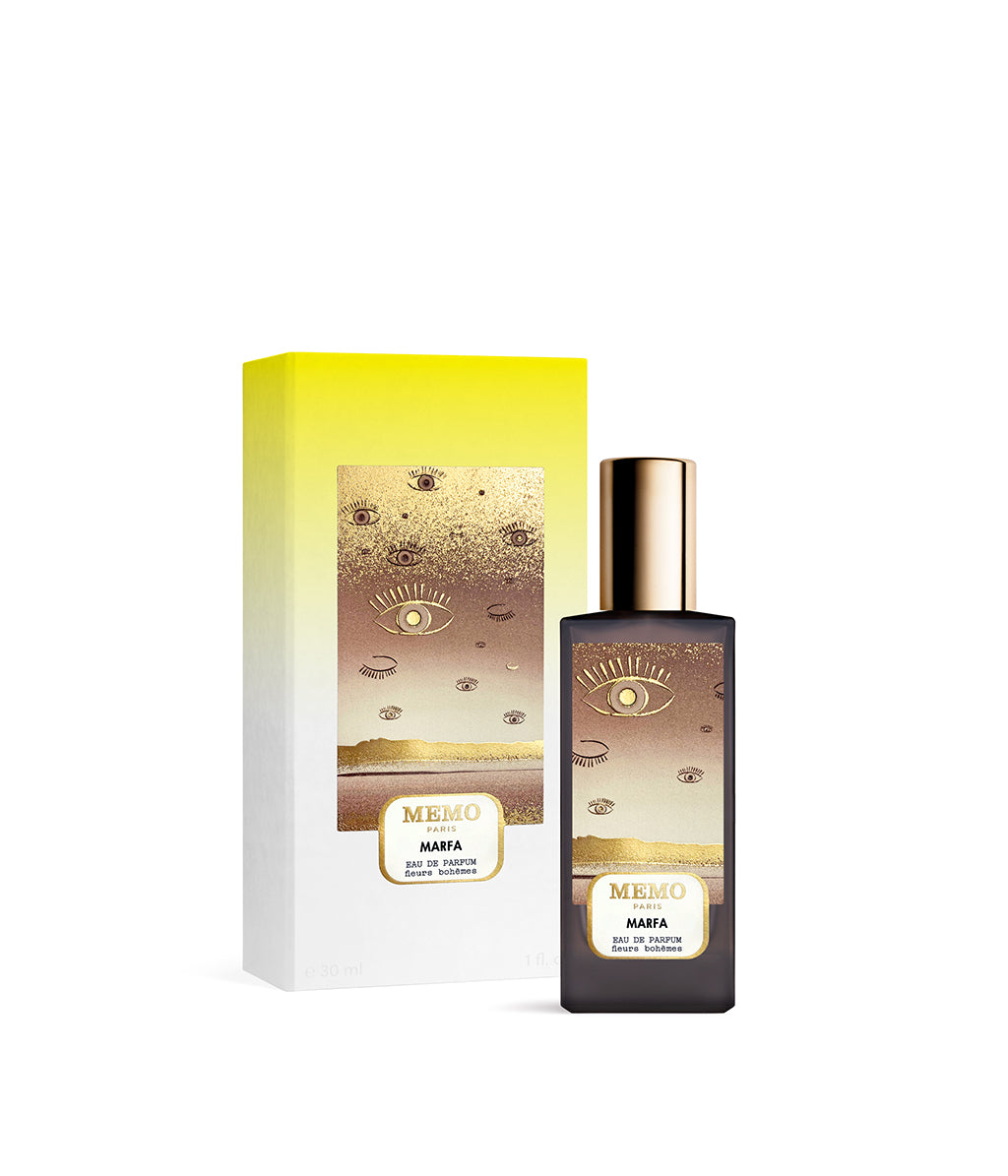
Memo Paris - Marfa
Marfa – A Mood Picture
Your eyes are fixed on the sky, the desert forgotten. Tuberose is your guiding star and your shepherd. A riddle will come, infinity hidden behind facades, silence under cacti. A slow-motion western, a series of artfully cut scenes. When the Milky Way traces its azure path, you just fly by; a road, half cedar, half sandalwood, rises before you. Monolithic shadows greet you, sculptures or dreamlike mountain ranges, worlds intertwined. You know how to stop the wind, combine musk with the shrill patterns of colorful neon light, lift the dust from the orange blossom. It doesn't matter that the heat is weighing you down, drunk on blue, driven by memories. Guided by a last glimmer of ylang, vanilla extends its hand. Here your life is a book full of stories. Marfa: your theater, your poem, your creation, your invention.
Marfa – A Fragrance in the Face of Tuberose
At the crossroads of Routes 90 and 67, deep in the Texan hinterland, three hours from the nearest airport: Marfa. A place with a unique destiny, chosen by Memo to launch the "Art Land" collection. The wide-open eye adorns the bottle, a first hint: Marfa gives you a sign and stares at you intently. Despite the blazing sun and annoying dust, the oldest inhabitants of this isolated American town, lost on a dry high plateau of the Chihuahuan Desert: The eye rests. For Marfa has an incomparable attraction, Marfa captivates every visitor with its magic.
A fragrance can do the same if it creates a magical connection. The encounter with Memo was as predetermined as with Tuberose Absolute: the floating, unforgettable scent of a blossom, related to the agave family, which blooms in the heart of the deserts. Tuberose reveals itself in the top note accord of Marfa and brings to life the unique nature of a white-glowing landscape before our eyes.
Where does Marfa get its power? The history of the place is one of creative intuition. The name is said to have been suggested by the bibliophile wife of a railway manager - after the heroine in Dostoevsky's "The Brothers Karamazov". Another explanation attributes the name to Marfa Strogoff, a character in Jules Verne's novel "Michael Strogoff". Later, the literary memento became a coveted film set - in 1959, "Giant" with James Dean and Elizabeth Taylor was filmed here.
Giant. The term is destiny for a city that became home to great art in connection with nature. In 1971, the artist Donald Judd left the metropolis of New York behind for this distant and hypnotic landscape. Here he wanted to create and present his art, and promote the works of contemporaries such as Dan Flavin and Richard Chamberlain: in deserted buildings and on seemingly boundless land. Thus, Marfa gradually became a vanishing point for art - and still is today. Flowers of metal, concrete, aluminum and neon bloom in this landscape. The fragrance Marfa has picked them and reinvented the bouquet.
When night falls and art begins to dream, the sky grabs the torch: a unique display of light that crosses the night and follows the eye. The city becomes the stage for an enigmatic, total light artwork. The senses are sharpened and the eye wide open to experience this nocturnal dance - and to grasp the grandeur of Marfa's magic.
