

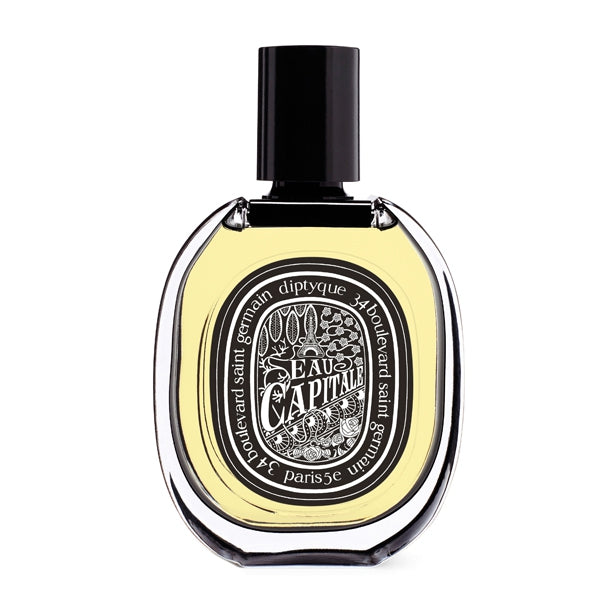
Eau Capitale is DIPTYQUE's first chypre fragrance, thus reinterpreting this principle conceived over a hundred years ago. Olivier Pescheux, a top-class perfumer and loyal companion of the brand, has taken the trouble to make it shine anew in the light of the 21st century. As an "abstract", enigmatic perfume, it embodies that slightly detached elegance associated with the "City of Lights" and Parisian flair. The fragrance opens with the "green of bergamot", whose freshness rounds off the predominant sensuality: naturally fruity, yet very lively and zesty, full of citrus juiciness. Were pink peppercorns mixed in to evoke the pomanders (oranges studded with cloves) that Desmond brought from England back then? Or to orchestrate the much-anticipated "olfactory coincidence"? Between the flower and the spice stands an exclamation mark, grand and worthy of a capital city.
At the center of the triangle is a bouquet of flowers, excessive in its opulence. The petals wide open, just before fading, an intense, "candied" scent aura of Bulgarian and Turkish rose and ylang-ylang from the Comoros. François Coty undoubtedly used the Grasse variety of Centifolia (also known as May rose) in his time.
Today it has almost disappeared, but botanists managed to replace it with particularly delicate cultivated varieties planted in Eastern Europe. Even the residual water from its distillation, which is also used in Eau Capitale, still gives off a divine scent. Ylang-ylang, on the other hand, with its sensual sweetness, is reminiscent of English candies that you can never get enough of. A long-lasting fragrance that proves to be a loyal companion. An essence of cinnamon bark provides the subsequent woody notes. Finally, the perfumer takes the liberty of using neither lichens, moss, oak nor pine, but patchouli. Its leaves are harvested and distilled in Indonesia, respecting all ethical principles of sustainable development. Spiced with a facet of "Akigalawood," which is created by an enzymatic reaction of the plant through contact with bacteria. Finally, a hint of "Georgywood," which brings in the earthy and dark aspects of vetiver. Rounded off by Ambrofix, with notes between musk, tobacco and gray amber...
Seeing well to smell (even) better
At the beginning of the DIPTYQUE saga were brushes, pens, colors, paper. And canvases. For long before the fragrances, what united the brand's founders above all was art: Yves, the former student of the École du Louvre, Desmond, who had studied fine arts, and Christiane, the graduate of the Arts Décoratifs. The first became a set designer, while the other two were already designing furniture fabrics together. They painted always and constantly. With this knowledge, it becomes clear how important the visual was and still is in the conception of their perfumes – because they always tell a story. Each of the three friends had their own area of responsibility within their partnership – Yves was the director, Christiane the artist with fairy fingers, Desmond the natural inspirer. The latter was responsible for designing labels, packaging and signatures.
With his ink stroke, he set black against white, sometimes winding, sometimes symmetrical. His script was integrated into the iconic oval: his logo, recognizable among thousands. The trio is no longer with us, but their spirit remains. Each new creation provides an opportunity to remember it. For the design of the Eau Capitale bottle, DIPTYQUE commissioned Pierre Marie, an ornamentalist (as he calls himself) and long-time companion of the house. His overflowing images, strongly inspired by Art Nouveau, the English Jugendstil, read like a novel: from the front to the back of the bottle, from outside to inside, as if one were turning pages to learn more.
The Birth of Chypre
If you look closely, besides the aforementioned bathroom, there are surprisingly many other connections between DIPTYQUE and this short turn-of-the-century era: The swan, then the symbol of feminine grace, has long been present in the brand's iconography and shapes the identity of l'Ombre dans l'Eau. The same applies to the peacock with its incomparable plumage, another symbolic bird from the Belle Époque, which has been featured in the panoramic illustration of the perfume l'Eau since 1968. Orientalism was a true passion of the founders Desmond Knox-Leet, Christiane Gautrot and Yves Coueslant. English painters and graphic artists such as Arthur Rackham, Aubrey Beardsley or William Morris inspired Desmond with their indescribably beautiful, stylized book illuminations for the design templates for the vignettes that would henceforth adorn the bottles. Moreover, at the same time, the art of perfumery reinvented itself through the use of chemical fragrances and entered modernity. Joseph Marie François Spoturno, better known by his alias François Coty, is considered the founder of this development. What remains of his work? Materially almost nothing: some metal containers in a safe of the fragrance archive, the Osmothèque of Versailles. Culturally, however, the foundation of what for decades was considered the pinnacle of "Parisian chic" and became the most famous fragrance structure in perfume history: Chypre.
This is what lies behind it: Chypre is a fragrance architecture that results from the boiling points and the respective evaporation rate of the raw materials used. Chypre: First, citrus or green notes like bergamot and verbena flash for 5 to 30 minutes. Then, dominant floral, spicy or fruity notes like rose and jasmine continue and carry the work for one to several hours... What remains are wood and root accents, gum resin and absolutes, which sometimes last an entire day: patchouli and oakmoss. The whole takes the form of a pyramid, from the top to the foundation: head, heart, base.
