


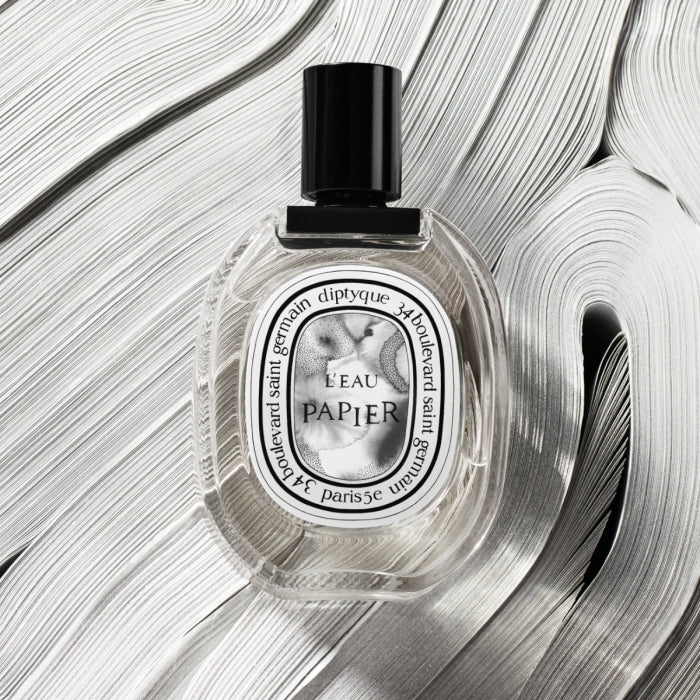
This composition is the result of the vision and imagination of perfumer Fabrice Pellegrin.
“Creating a perfume for DIPTYQUE is like writing a book. You need a story, an introduction, a structure, and also raw materials that complement each other and weave into a narrative. For L’Eau Papier, I started with a main ingredient: grain, specifically sesame and an extract from its roasted seeds. This note forms the surprising element of the perfume, with which I wanted to evoke the smell of ink and introduce a sophisticated, indulgent nuance. I then refined the composition with musk notes to give it more sensuality. To round it off, I added floral notes of mimosa, whose delicate powdery properties emphasize the soft note representing paper. The scent is defined by the uniqueness of the grain and ink accord in combination with the sweet scent of white musk, which represents the smell of paper. I translated the delicate and sensitive contact of the ink with the sheet through an overdose of musk.”
Just as ink penetrates different sheets of paper differently, L’Eau Papier will produce different results from one skin to another and over time – thanks to the way white musk develops and unfolds. L’Eau Papier is a complete symbol of paper – and a way for every personality to express their unique individuality.
White Musk
It all starts with a blank sheet of paper. Then ink and ideas come into play. Imagination and the senses determine the line, dreams and experiences shape the forms. This is how things have always begun – for artists from all over the world, as well as for Desmond Knox-Leet, Christiane Montadre-Gautrot, and Yves Coueslant, the three multidisciplinary creators and DIPTYQUE founders with their shared love for beauty, art, and expressive drawings.
Unique to the house is that the discovery of scents first occurs through sight and graphic expression, which tells the story and composition of the perfumes. A blank sheet of paper and a black line form the beginning of the creative gesture, creating the connection from nose to hand. Optics, scent, and image link together into a unique process of fragrance creation, a true synesthetic experience.
Rice Steam Accord
This was naturally also the creation process of L’Eau Papier, the DIPTYQUE Eau de Toilette, conceived in collaboration with perfumer Fabrice Pellegrin and artist Alix Waline. With its history, its characteristics, and its name, L’Eau Papier is a true homage to creation, the heart of the house, and to paper, the most important medium through which this creation is expressed. Paper as an impulse for ideas, as an essential basis for the creation of drawings and fragrances, which in turn stimulate the imagination of each individual by telling stories and awakening memories. The name of this new creation not only equates water and paper but also recalls the history of the house and the founding trio's passion for the line and the brushstroke. The name alludes to ink diluted with water, through which the form materializes on the sheet, and to the artist's gesture as they compose their drawing, giving free rein to their imagination.
The French artist Alix Waline, trained at the School of Fine Arts in Paris and the École de la Cambre in Brussels, has created a work in her characteristic delicate black and white style, multiplying shadows and textures and building the drawing point by point and layer by layer. Unlike the traditional illustrations of DIPTYQUE perfumes, there are no recognizable figures or landscapes, but rather an impressionistic and abstract black-and-white composition.
On the front, the varying color intensity of the motifs and strokes illustrates the many possibilities of putting art on paper, revealing a wealth of different nuances and emotions. Everyone is free to interpret the drawing in their own way and imagine a personal story. More than ever, the viewer's eye determines the work, guided by their own imagination.
L’Eau Papier – Mimosa and a Bright Wood Accord
Alix Waline’s drawing on the back reflects her vision of the fragrance and its peculiarities, reminiscent of the pointillist style of Desmond and Yves, which shaped the identity and character of DIPTYQUE illustrations. A washed-out ink emphasizes the softness and material properties of the paper grain and white musk. A multitude of small, closely spaced strokes symbolizes the rice steam accord, as delicate as the fine rice paper on which the drawing was applied. The series of fine grooves represents the woody accord – wood is both a symbol of permanence and the basic material for paper. Delicate brushstrokes with diluted ink are intended to embody the lively note of mimosa, which adds a subtle touch of sweetness.
